How to start homeschooling in the UK: a practical guide for your first weeks

The first weeks of home education don't need to look like school at home. There is no legal minimum number of hours, no requirement to follow the National Curriculum, and no national rule about what a homeschooling day should contain. For families who have just come out of a school crisis, the first weeks are about settling rather than scheduling. The fear of not doing enough is almost always bigger than the reality.
If that sounds counter to everything you've been told about education, that's because it is. Most of the anxiety parents carry into the first week home comes from comparing it to school, and most of what felt true about school doesn't apply once you're not at school anymore.
There is no legal minimum number of hours
A lot of parents arrive at the first week of home educating with one anxiety louder than all the rest: am I doing enough? It surfaces several times a day in the first weeks, usually rooted in the comparison to school, where six hours a day is the assumed baseline.
The actual answer, once you let it settle, is freeing. There is no legal minimum number of hours in English law. Section 7 of the Education Act 1996 defines a "suitable" education by fit to the child (their age, ability, aptitude, and any special educational needs), not by hours on a clock or by content covered. The DfE's 2019 guidance for parents confirms there is no prescribed structure for home education.
Many home-educating families report that two to four focused hours a day works well in the first weeks, with unstructured time around it. This is community wisdom rather than a rule, and it has no statutory basis. But it tends to line up with what families actually find sustainable: short blocks of focused work, then space for the rest of the day to be lived.
The first weeks are not the rest of your life
A common mistake new home-educating parents make in the first weeks is treating them as a teaching project. Many home educators describe a transitional period in the first few weeks or months called "deschooling": both child and parent settling into something that does not yet have a shape. This isn't an academically-researched concept. It's practitioner wisdom, widely referenced in the home-ed community. The experience it describes is real.
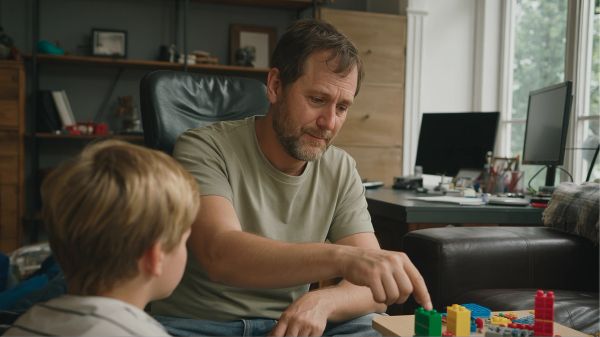
For children who have been unhappy or unwell at school, the first weeks home are often more about decompression than learning. They may resist structure. They may sleep more, talk less, drift around the house in a way that looks like nothing is happening. They may seem to "fall behind". This is not failure. It is a transition, and for families who have come out of a school crisis, it is often the foundation everything else is built on.
What a realistic first week might look like
Different families do this differently, and that is the point. What follows is one realistic shape for a first week, not a model to copy.
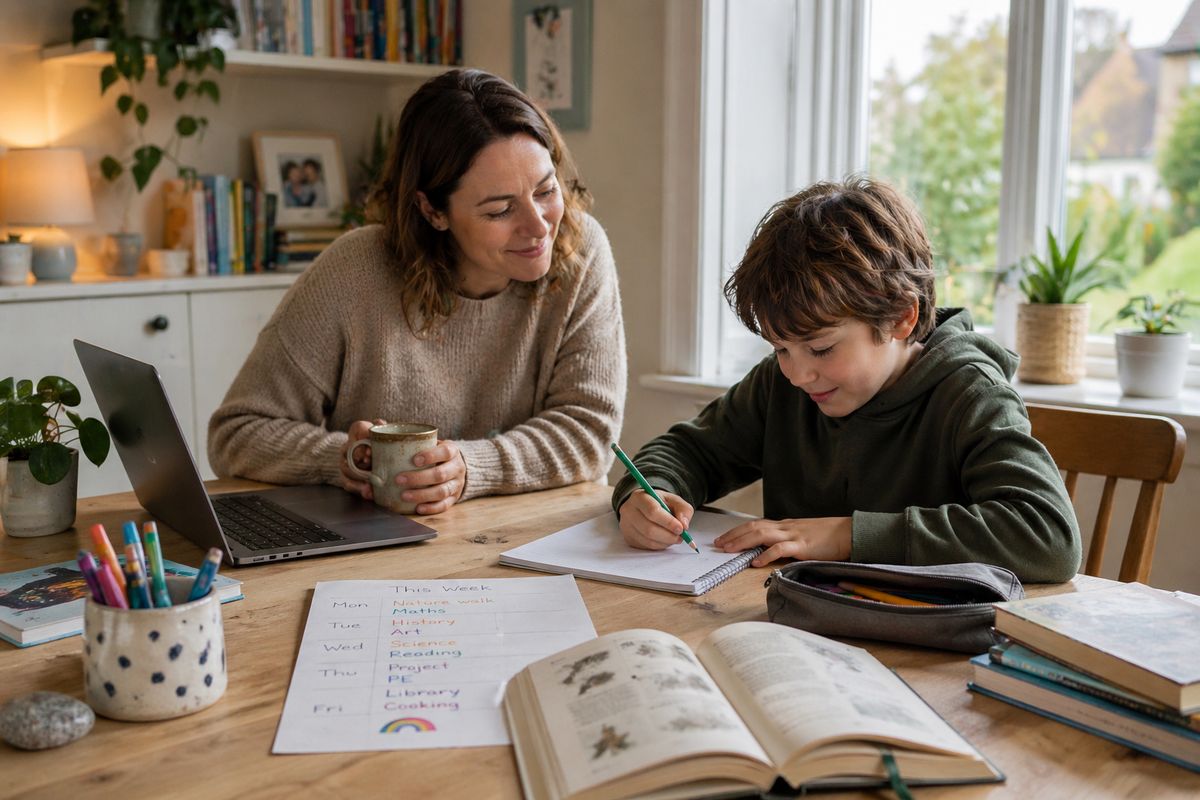
A morning might start with something practical: reading together, a maths workbook page, or a project the child has chosen. An hour, maybe ninety minutes. Then a break that lasts as long as it lasts. Some children come back ready for more after fifteen minutes; others need longer, and the day rolls forward. The afternoon might be time outside, or a visit somewhere, or a creative thing nobody calls "art" out loud. Some days nothing structured happens at all. Some days the structure breaks down halfway through. Both are normal in the first weeks.
"Focused" looks different for different children. For one child it's twenty minutes of full attention on a maths puzzle; for another it's two hours building a model. Both count. The sum across a week matters more than the shape of any single day.
Finding other families is not optional
The single biggest mistake new home-educating families make is going it alone. In our conversations with home-educating parents, the recurring theme is that community is what makes home education sustainable. Without it, even families who chose home education positively struggle. With it, families who arrived through crisis find their footing surprisingly quickly.
Most home-educating families find each other through Facebook groups, local meet-ups, and word of mouth. Search for groups in your county or town. Many areas have a long-running home-ed group with weekly meets, walking groups, or hire-a-hall sessions where children of mixed ages play and parents catch a breath. Some are tied to a particular approach (Charlotte Mason, unschooling, faith-based), others are completely mixed. There is no expectation that you align with a particular philosophy to join.
Online communities are also active and useful for late-night questions, but the in-person community is what most families say carries them through the first year. Even one local connection in the first weeks tends to change the texture of the whole experience. Termly is a UK platform built to make that local connection easier.
What the law does and does not ask of you
The legal framework is much shorter than most parents expect. Section 7 of the Education Act 1996 sets the parental duty to secure an "efficient, suitable, full-time education", and the word "suitable" is defined by fit to the child, not by hours, curriculum, or assessment. The DfE's 2019 guidance for parents confirms there is no requirement to follow the National Curriculum, keep school hours, or hold formal teaching qualifications.
Your local authority's elective home education team will usually be in contact at some point after you deregister your child from school. This is normal and routine, not an investigation. You are not required to allow home visits, follow a particular curriculum, or respond on any particular timetable. The DfE 2019 guidance is clear that LA enquiries are proportionate to specific concern, not a routine monitoring mechanism.
Ofsted does not inspect home-educated children.
Your LA may have its own published guidance on how it runs its home-education team, and the GOV.UK postcode lookup is the quickest way to find your council's page. Your LA may differ in style and tone from another LA a few miles away; the underlying legal framework is the same in every English local authority area.
You haven't fallen behind
If you take only a handful of things from these first weeks, take these. There is no legal minimum number of hours. Two to four focused hours a day is plenty at first, and the structure of the day matters less than whether your child is settling. The first weeks are usually a transition, not a teaching project. And finding other home-educating families nearby is one of the most important steps you can take.
If you're reading this in the early evening of a quiet first day, or after one that didn't go anything like you'd hoped, or in a worried moment somewhere in week two: the place you are right now is not the place this stays. According to DfE figures, 71,500 children started home education in England in 2023/24 alone. Mental health is the most commonly recorded reason for home education in England. Many of those parents are sitting where you are now, with the same questions and the same concerns.
The most useful thing in these first weeks is rarely what feels most productive. Reading carefully. Staying close to your child. Letting the days pass without grading them. That is the foundation. The rest follows.
Sources
- Education Act 1996, Section 7. Parental duty to secure an efficient, suitable, full-time education. legislation.gov.uk
- Department for Education: Elective Home Education, Guidance for Parents (April 2019). Non-statutory departmental guidance on the legal position, suitable education, the National Curriculum, and local authority enquiries. assets.publishing.service.gov.uk
- Department for Education: Elective Home Education statistics. Source for the 71,500 starters in 2023/24 figure and mental health as the most commonly recorded reason cited above.
- GOV.UK: Home education. gov.uk/home-education
- GOV.UK: Contact your local council about home schooling. gov.uk/home-schooling-information-council